
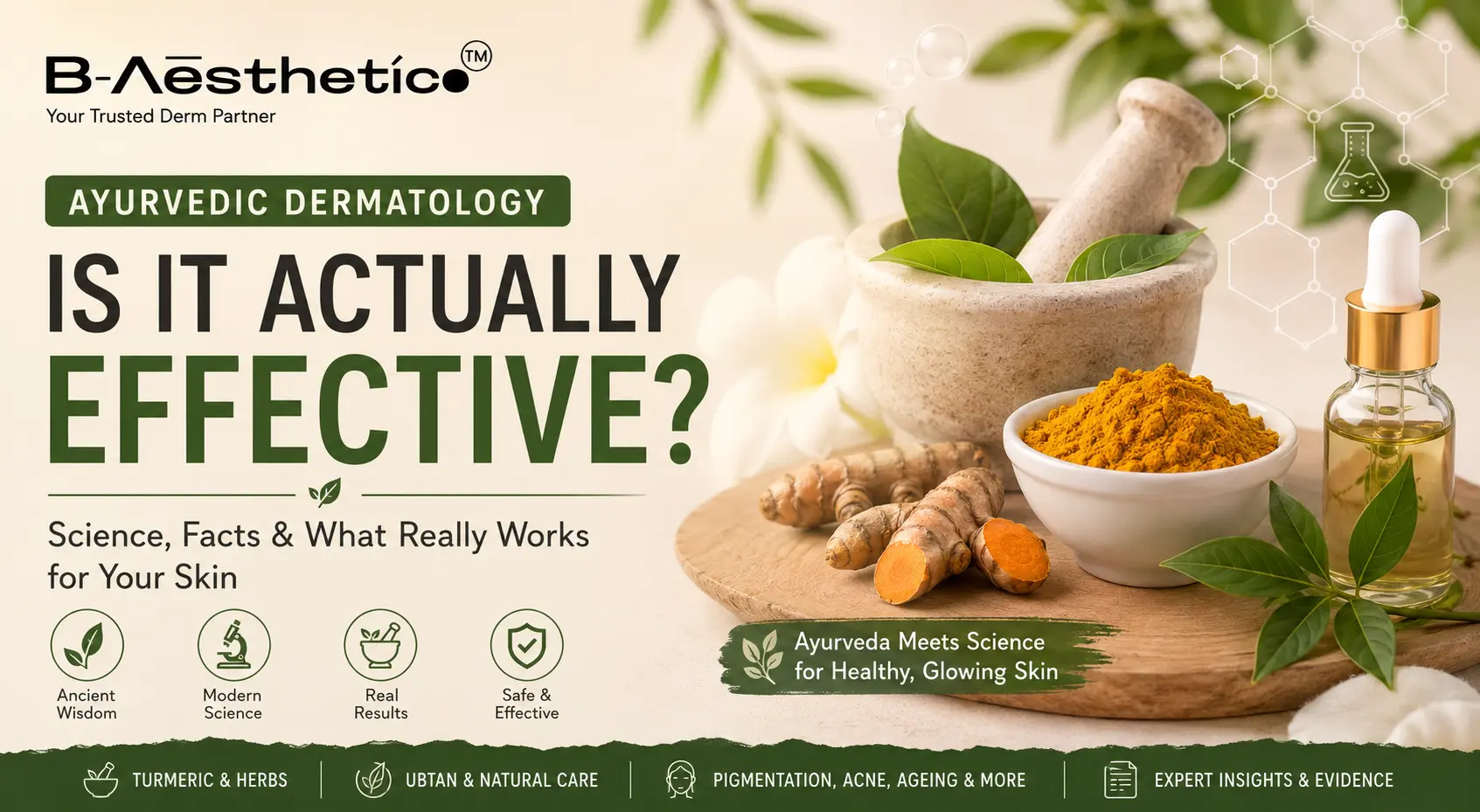
For generations, Indian homes have turned to turmeric, neem, sandalwood, aloe vera and other botanical ingredients when skin needed a little extra care.
And today, Ayurvedic skincare is everywhere.
Face packs. Herbal oils. Ubtans. Plant-based serums. Traditional remedies are being rediscovered, but one question keeps coming up:
Does Ayurvedic dermatology actually work, or is it simply an old beauty tradition dressed up for modern skincare?
Some Ayurvedic ingredients have demonstrated biological and clinical effects in modern research. Turmeric, for example, has been studied for its anti-inflammatoryand antioxidantproperties, with clinical research exploring its role in conditions ranging from psoriasisand pruritusto facial rednessand photoaging. At the same time, systematic reviews repeatedly point out that the overall evidence remains limited, formulations vary widely, and larger, better-designed human trials are still needed.
So Ayurvedic dermatology can have a place in modern skincare.
But it needs to be used intelligently.
What Exactly Is Ayurvedic Dermatology?
Ayurveda views skin health as part of overall health rather than treating the skin as an isolated organ. Traditional Ayurvedic practice may consider diet, lifestyle, constitution, topical herbs and broader patterns of health when approaching a skin concern.
Modern dermatology starts from a different framework. It classifies conditions according to anatomy, pathology, inflammation, infection, immune responses, hormones and other measurable biological processes.
These approaches do not always ask the same questions. But that does not mean they cannot coexist.
In fact, research into traditional and complementary approaches to dermatology has identified promising botanical ingredients and traditional practices while also highlighting the need for stronger clinical research and better standardisation.
The key is knowing what has evidence behind it, what is still experimental, and what should never replace established medical treatment.
Does Turmeric Really Help the Skin?
Turmeric is probably the most recognisable Ayurvedic skincare ingredient.
And there is genuine science behind the interest.
Curcumin, one of turmeric's major active compounds, has antioxidant, anti-inflammatoryand antimicrobialproperties. A systematic review of human clinical studies found potential benefits across several dermatological conditions, although the researchers also noted that the number and quality of studies were limited.
A more recent systematic review examining randomized controlled trials found encouraging evidence for certain uses, particularly psoriasis, pruritus and some scar-related outcomes, while evidence for several other conditions was less established. The review also stressed the need for better dosing, delivery systems and larger trials.
That distinction matters.
A promising ingredient is not automatically a proven treatment.
And turmeric powder from the kitchen is not the same thing as a standardized topical formulation containing a defined concentration of curcuminoids.
This is where modern formulation science becomes important.
Why Traditional Ingredients Work, But Not Every Remedy
The phrase "natural skincare" can create a misleading impression. Natural does not automatically mean effective. Nor does it automatically mean gentle. And natural certainly does not mean suitable for every skin type.
A botanical ingredient can contain biologically active compounds. Those compounds can interact with skin cells, inflammatory pathways, microbes or oxidative processes. But the final outcome depends on concentration, purity, extraction method, formulation, stability, penetration and how frequently the product is used.
That is why rubbing raw ingredients onto your face is not equivalent to using a properly formulated cosmetic product.
The same principle applies to home remedies.
Raw lemon juice, for example, is not a sensible pigmentation treatment simply because lemon contains vitamin C. Highly acidic DIY preparations can irritate skin, and irritation itself can worsen post-inflammatory pigmentation.
This is one reason B-Aesthetico'seducational approach repeatedly comes back to consistency, appropriate formulations and understanding the actual skin concern rather than chasing an overnight fix. Our recent pigmentation guidemakes the same distinction between pigmentation causes and the practical steps used to manage it.
Ubtan In Modern Skincare
Ubtan is a beautiful example of tradition meeting contemporary skincare.
The Rituals Renewed Ubtancombines ingredients including turmeric, saffron, neem, orange, lemon peel, tulsi, rose water and sandalwood. It is a skin-exfoliating and glow-focused product that helps remove surface dirt and dead skin and improve the appearance of dark spots.
Although an ubtan may support exfoliation, cleansing and a brighter-looking complexion, it does not mean it should be described as a cure for melasma, acne, eczema or another dermatological disease.
There is a difference. A cosmetic can support healthier-looking skin. A medical treatment targets a diagnosed condition.
If pigmentation is persistent, recurring or spreading, simply exfoliating harder is unlikely to solve the underlying cause. Sun exposure, hormones, inflammation and other factors can all contribute to pigmentation, which is why prevention and targeted treatment matter.
Ayurvedic Skincare and Pigmentation: What Actually Helps?
Pigmentation is one of the areas where patience matters most.
Melanin production can increase in response to UV exposure and inflammation. Once pigmentation develops, repeatedly irritating the skin can keep the cycle going. Think gentle. Think consistent. Most importantly, think protection.
The Skin Saver SPF 50+++is a broad-spectrum sunscreen for UVA and UVB protection. Our experts recommend daily application and reapplication during prolonged sun exposure.
That fits into a principle we have already explored in our recent SPF guide: sunscreen is not simply about avoiding sunburn. Daily UV exposure also matters when tanning and uneven pigmentation are the concern.
And there is another useful reminder from our guide to tanning despite sunscreen. Wearing SPF does not make UV exposure disappear completely. Under-application, missed reapplication, sweat and long periods outdoors can all affect real-world protection.
Traditional skincare can support the routine.
Sun protection protects the progress.
What About Acne, Eczema and Psoriasis?
There is research into botanical ingredients for inflammatory and dermatological conditions, including turmeric and other plant-based compounds. But evidence for an individual ingredient is not the same as evidence for an entire Ayurvedic treatment system, and neither is automatically enough to replace established medical therapies for chronic skin disease.
A person with mild cosmetic dullness is in a very different situation from someone with persistent inflammatory acne, eczema, psoriasis, rosacea or an infection. The diagnosis comes first. The treatment comes second.
For everyday cleansing, our Creamy Cleanseris formulated with ingredients including hyaluronic acid, Japanese rice water, probiotics, aloe vera, ginseng and jojoba oil. It is a great cleansing, soothing and hydrating option.
That kind of gentle foundation is often more sensible than constantly changing masks and home remedies.
Our recent Skinimalism articlemakes a similar point: a routine does not become better simply because it contains more steps. Consistency is easier when the routine is practical.
Can Ayurvedic Skincare Help With Aging Skin?
Oxidative stress, chronic inflammation, cumulative UV exposure and changes in collagen and the skin barrier all contribute to visible skin aging. Some botanical compounds have antioxidant or anti-inflammatory properties that are biologically interesting, but that does not make every herbal cream an anti-aging treatment.
The Active Serum, for example, is designed around concerns such as dark spots, uneven tone, hydration and visible signs of aging. The ingredient list includes niacinamide, arbutin, ceramide 3, aloe vera extract and other actives.
That is not traditional Ayurveda in a strict classical sense. Modern skincare can borrow from nature without pretending that modern formulation science does not exist.
The same applies to our Derma Defender Serum, which is a hydrating and skin-protecting serum aimed at wrinkles, fine lines and moisture restoration. Its formulation includes argan oil and other cosmetic ingredients alongside emollients and vitamin E.
The future of good skincare does not have to be "traditional versus modern." It can be informed by both.
Is Ayurvedic Dermatology Safe?
The answer depends heavily on the product.
Some Ayurvedic preparations can contain metals or minerals, and certain products have been found to contain lead, mercury or arsenic in potentially toxic amounts. This is why sourcing, manufacturing standards, testing and formulation quality matter enormously.
That does not mean every Ayurvedic or herbal product is dangerous. It means the label "Ayurvedic" is not a safety certificate.
Choose products with clear ingredient information and appropriate quality controls. Patch testing is sensible when introducing a new topical product, particularly when you have sensitive skin or a history of reactions.
Our products undergo laboratory testing and formulations are developed with specialist input. That quality-control is important regardless of whether the ingredient came from a laboratory or a garden.
Is Ayurvedic Dermatology Actually Effective?
Yes, in some situations. But not in the exaggerated way social media sometimes presents it.
There is meaningful scientific interest in several traditional botanical ingredients, and some clinical studies show encouraging results. Turmeric and curcumin are among the better-studied examples. Yet the evidence remains condition-specific, formulation-specific and sometimes preliminary.
Ayurvedic-inspired skincare can be particularly valuable when the goal is gentle cleansing, hydration, exfoliation and support for healthy-looking skin.
But when someone has a diagnosed dermatological condition, the priority should be accurate assessment rather than blindly following a home remedy.
Your skin is not generic.
Your routine should not be either.
This is why our experts at B-Aestheticoencourage people to understand their skin and hair more closely rather than simply collecting products. Our Free Consultationcan help connect users with skin and hair specialists for personalized guidance.
The Best Way to Think About Ayurvedic Skincare
Traditional wisdom can offer valuable ingredients and practices. Modern dermatology offers standardized diagnosis, controlled research and evidence-based treatment. Modern cosmetic formulation helps turn useful ingredients into stable, usable products.
There is room for all three.
For sun-exposed skin, the Beach Kitbrings together our De-Tan Body Wash, De-Tan Body Polisherand the Derma Defender Serum, and our de-tanning guidereinforces a simple truth: preventing repeated UV exposure is just as important as caring for skin that has already become tanned.
Good skincare does not have to reject tradition. It simply needs evidence, quality and common sense. And sometimes, the most nurturing thing you can do for your skin is not add another remedy. It is finally giving it the right one.
FAQs
Is Ayurvedic skincare scientifically proven to work?
Some Ayurvedic ingredients have been studied in clinical research, particularly botanicals such as turmeric and its active compound, curcumin. Research suggests potential anti-inflammatory, antioxidant and other dermatological benefits, but the strength of evidence varies by ingredient, formulation and skin condition.
This is why it is better to evaluate the individual ingredient and formulationrather than assume that every product labelled Ayurvedic will produce the same results.
For a deeper explanation, read our guide on how pigmentation develops and the best ways to care for it.
Can turmeric really improve skin?
Turmeric contains curcumin, a compound that has been investigated for its antioxidant and anti-inflammatory properties. Human studies have explored curcumin for several dermatological concerns, although more high-quality research is needed before making broad treatment claims.
Traditional turmeric use can therefore be interesting from a skincare perspective, but applying raw turmeric powder is not the same as using a properly formulated cosmetic product.
If you enjoy traditional skincare rituals, Rituals Renewed Ubtanbrings ingredients such as turmeric, saffron, neem, tulsi and sandalwood into a dedicated skincare formulation.
Is Ayurvedic ubtan good for pigmentation?
An ubtan may help with surface exfoliation, cleansing and the appearance of dull or uneven-looking skin, but pigmentation has many possible causes, including UV exposure, hormonal changes, acne-related inflammation and ageing.
That means an ubtan should be viewed as part of a skincare routine rather than a guaranteed treatment for melasma or persistent hyperpigmentation.
Our Rituals Renewed Ubtanis designed around the traditional ubtan concept, while our Triple Action Creamis specifically positioned for concerns such as pigmentation, freckles, dark spots and uneven skin tone.
You can also read our complete guide to pigmentation, its causes and treatment.
Can Ayurvedic skincare remove dark spots permanently?
No skincare product should promise permanent removal of every dark spot. The outcome depends on what is causing the pigmentation in the first place.
Sun exposure, acne, inflammation, hormonal changes and ageing can all contribute to uneven pigmentation. Consistent sun protection is therefore just as important as the products used to target existing pigmentation.
Our Skin Saver SPF 50+++provides broad-spectrum UVA and UVB protection, while our Triple Action Creamis formulated around pigmentation and uneven-tone concerns.
For more on this, read Why Am I Still Tanning Even Though I Use Sunscreen?.
Can I use Ayurvedic skincare every day?
You can use an Ayurvedic-inspired skincare product regularly when its formulation is suitable for your skin and the product is intended for frequent use. The important factor is not simply whether something is "natural", but whether the ingredients, concentration and formulation suit your individual skin.
A simple routine can often be more sustainable than constantly switching between different remedies. Our Skinimalism guideexplains why a shorter, more practical routine can sometimes be easier to maintain consistently.
Is Ayurvedic skincare safe for sensitive skin?
It can be, but "natural" does not automatically mean gentle. Botanical extracts, essential oils, fragrances and even familiar ingredients can cause irritation or allergic reactions in some people.
If your skin is sensitive, introduce new products gradually and patch test when appropriate. A gentle cleanser can also help keep the rest of the routine simple.
For everyday cleansing, B-Aesthetico Creamy Cleanseris formulated with ingredients including hyaluronic acid, Japanese rice water, probiotics and aloe vera and is positioned to cleanse while helping prevent moisture loss.
Can Ayurvedic skincare treat acne?
Some botanical ingredients have antimicrobial or anti-inflammatory properties and are being investigated for acne and other inflammatory skin conditions. However, evidence for Ayurvedic treatments as a whole is not strong enough to say that they can replace established acne treatments.
For occasional breakouts, a sensible skincare routine can help support the skin. Persistent, painful or scarring acne is a different situation and may require targeted dermatological care.
Start with the basics: gentle cleansing, appropriate treatment and daily sun protection.
Can Ayurvedic skincare help with ageing skin?
Some botanical compounds have antioxidant and anti-inflammatory properties that may support healthy-looking skin, but ageing is influenced by much more than one ingredient.
Cumulative UV exposure, collagen changes, oxidative stress and changes in the skin barrier all contribute to visible ageing. That makes daily sunscreen and a consistent skincare routine particularly important.
B-Aesthetico's Active Serumis formulated around concerns including dark spots, uneven tone, hydration and visible signs of ageing, while the Derma Defender Serumfocuses on hydration, skin protection and elasticity.
You can also explore our guide to anti-ageing treatments and what actually works.
Can I use Ayurvedic skincare instead of seeing a dermatologist?
Not necessarily.
Ayurvedic-inspired skincare may have a useful role in everyday skin maintenance, but persistent acne, eczema, psoriasis, rosacea, infections, significant pigmentation and unexplained changes in the skin should not simply be treated with home remedies.
The first step is understanding what you are actually treating.
If you are unsure which products or treatments are appropriate for your concern, you can book a Free Consultation with B-Aesthetico's skin and hair specialistsfor personalised guidance. B-Aesthetico's consultation service specifically states that recommendations are tailored to an individual's skin type, concerns and goals.
What is the difference between Ayurvedic skincare and Ayurvedic dermatology?
Ayurvedic skincare generally refers to cosmetic products or routines inspired by Ayurvedic ingredients and traditions. Ayurvedic dermatology is a broader therapeutic approach that may consider traditional Ayurvedic principles, lifestyle, diet and herbal preparations when addressing skin concerns.
They should not be treated as interchangeable terms.
A turmeric-containing face product, for example, is not automatically an Ayurvedic medical treatment. Similarly, using an Ayurvedic-inspired cosmetic does not mean that a diagnosed dermatological condition has been treated.
Is "natural" skincare better than modern dermatology?
Not automatically.
Natural ingredients can be useful, and modern dermatology has also investigated several botanical compounds. But effectiveness depends on the specific ingredient, formulation, concentration, skin concern and quality of evidence.
The better question is not natural versus synthetic.
It is: Does this particular product make sense for this particular skin concern?
That is the philosophy behind combining traditional ingredients with modern formulation and evidence-based skincare rather than treating the two as opposites.
Latest Posts




Related Articles

Men vs Women Skincare and Haircare: What’s Actually Different?
Men and women have real differences in skin and hair, but do they actually need different...
What Really Is SPF?
Have you ever looked at your sunscreen and seen the big, bold text saying, “SPF 50”?...
Why Am I Still Tanning Even Though I Use Sunscreen?
You bought the SPF 50. You apply it every morning. You even remember it on most...